Wednesday, December 3, 2008

From $2 To $7,721


TODAY, Thursday, 04th December, 2008
Tight credit lines actas brakes, even as small car premiums and dealer prices rise:
Neo Chai Chin
chaichin@mediacorp.com.sg:
IT was largely expected: The$2 Certificates of Entitlement (COE) for small cars proved a fluke, as prices in that category yesterday rebounded to $7,721. The figure, though, is still the third-lowest since 2005. A total of 3,149 bids were received for the 1,840 COEs on offer — a contrast to the last exercise on Nov 19, when the number of bids exceeded the quota by just one. Prior to the $2 fluke, small-car COEs had gone for $10,455 early last month. The latest premium falls within the range of what car dealers expected, and they believe COE prices will hold stable until the Chinese New Year.
"I think buyers are trying to get (their cars) before the festive season, so in the short term, COE prices should be around this (range)," said Mr Neo Nam Heng, president of the Singapore Vehicle TradersAssociation. He reckoned that dealers would need two more months to bid for COEs, to clear all the orders placed in the last two weeks.
Dealers had slashed prices by up to $10,000 in the wake of the record-low COE premium. But prices have inched up by a few thousand dollars since, moderated by market sentiment which is still relatively weak. Mitsubishi, for example, plans to raise prices for cars below 1,600cc by $1,000 soon, after a recent increase of the same amount. "Prices won't go up drastically," said a spokeswoman for its distributor, Cycle & Carriage. But demand is also dampened by another factor — full car loans are hard to come by from banks, with the ongoing credit crisis.
"Loan rejection rates are appalling — 30 to 40 per cent of the people (at our showrooms) could not get the full loans," said Mr Glenn Tan, group chief executive of Motor Image Enterprises, Subaru's regional distributor.
"So, I think that even with a bumper crop of people wanting to buying cars, the COEs have not gone to $10,000 or $15,000 because they cannot get loans."
COEs in the big cars, motorcycles and open categories also went up in yesterday's exercise. Prices for cars above 1,600cc rose from $4,889 to $6,501, while open category prices rose from $6,889 to $7,589. Motorcycle COEs rose slightly from $1,012 to $1,102. Only COEs in the goods vehicle and bus category fell, from $6,189 to $5,212.

Treadmill Workstation

Wanted


Wanted is a 2008 action film which is very loosely based on the comic book miniseries of the same name by Mark Millar. The film is directed by Timur Bekmambetov and stars James McAvoy, Angelina Jolie, Morgan Freeman, Thomas Kretschmann and Terence Stamp. Production began in April 2007. Wanted was released on June 25, 2008 in the United Kingdom and June 27, 2008 in the United States.

Plot
A young man named Wesley Gibson (James McAvoy) works at a dead-end job with an overbearing boss, takes anti-anxiety medication for panic attacks, and has a live-in girlfriend who cheats on him with his best friend. He speaks of how his father left when he was just one week old. He wonders if when he was born his father looked into his eyes and saw a failure.

Elsewhere, an assassin called "Mr. X" (David O'Hara) is targeted by a group of snipers, who he easily dispatches. However, he finds himself standing over an 'X' on the ground, and is killed by a rogue named Cross (Thomas Kretschmann) with an untraceable bullet. During one of his trips to the pharmacy, Gibson is told by a mysterious woman named Fox (Angelina Jolie) about how his father was killed, and that the killer, Cross, is behind him. Cross and Fox engage in a spectacular shoot-out followed by a car chase in the streets of Chicago.

Fox brings Gibson to the headquarters of The Fraternity, a thousand-year-old secret society of assassins. The group's leader, Sloan (Morgan Freeman), invites Gibson to follow in his father's footsteps as an assassin. To show him what he's capable of, Gunsmith (another assasin and member of The Fraternity) holds a gun to Gibson's head and has him shoot the wings off several flies. Gibson has a panic attack and does as asked. Sloan explains that his heart beats around 400 times a minute when he's stressed, sending massive amounts of adrenaline into his bloodstream, and that he can learn to control it. Gibson is initially reluctant and returns to work, only to finally snap after being shown a new possible life. He tells off his boss in front of the entire office. On his way out, he smacks his friend across the face with a keyboard. Fox is waiting outside to take him back to the Fraternity headquarters - an unassuming textile mill.

After much training, Gibson is shown the Loom of Fate, a loom that gives the names of the targets through binary code hidden in weaving errors of the fabric. Those the loom identifies are apparently destined to cause tragedy in the future, thus killing them spares those the person would have harmed. Fox experienced the result of failing to complete a hit when her father, a judge handling a sensitive case, was burned alive by a hired killer (the target) in front of her eyes. The man then burned his initials on her neck. After several routine missions and a chance meeting with Cross, in which Cross shoots him in the arm with a deliberately traceable bullet, Gibson becomes impatient and demands to be allowed to avenge his father. Sloan grants his wish, but then gives Fox a mission to kill Gibson.

Gibson and Fox travel to the Fraternity's original base of operations in Europe and capture the bullet-maker, Pekwarsky (Terence Stamp) who arranges a meeting with Cross. Gibson and Fox are tricked into separating, leaving Gibson to face Cross alone on a moving train. Fox steals a car and crashes it into the train, eventually causing the train to derail when it reaches a bridge over a deep ravine. Gibson is about to fall into the ravine before Cross catches his hand, saving his life. Gibson shoots him. Before Cross dies, he tells Gibson that he is his real father and that the Fraternity had been lying to him. Fox confirms the truth and explains that Gibson was recruited because he was the only person that Cross wouldn't kill. Fox then tells Gibson about the kill order on him, but Gibson escapes by shooting out the glass underneath him and plunging into the river below.

Gibson is retrieved by Pekwarsky, who takes him to his father's apartment, located across the street from his old home. Pekwarsky explains that Sloan discovered that he was targeted by the Loom of Fate, so he started manufacturing his own targets for profit. Cross discovered and went rogue. Gibson realizes that Cross had actually been targeting Fraternity members to keep them away from him. Pekwarsky departs after giving Gibson plane tickets, stating that his father wished him a life free of violence. Gibson, however, decides to take out Sloan after discovering a secret room containing all of his father's weapons and maps.

Using an army of rats that he lured and trapped with peanut butter and strapped plastic explosives and a detonator to them, Gibson mounts an attack on the Fraternity. He releases the rats into the textile mill and detonates them as a distraction. Upon entering Sloan's office after killing nearly every present fraternity member, he reveals Sloan's deception to the other master assassins left in the room. Sloan reveals that all of their names had come up in the weaving, and that he had merely acted to protect them. Were they to follow the code, every one of them should kill themselves on the spot. Otherwise, they should kill Gibson. The other assassins decide to kill Gibson, but Fox, realizing she has been part of a lie, turns on her fellow assassins. She "curves" a bullet to kill the assassins who had been standing in a circle, then throws her gun to Gibson before stepping back into the path of the bullet. Sloan escapes.

Gibson, penniless once more, does not know what to do with himself. While Gibson provides a voice-over, the audience sees a young man sitting in front of a computer much like Gibson did at the beginning of the film. Sloan appears and points a gun at the man's head. At that moment, the man turns around and is revealed to be a decoy (with the name of J.G. Millar, a reference to J. G Jones and Mark Millar, the comic series creators). Sloan finds himself standing on a marked spot. He is then killed by Gibson, who shoots him in the head from the same window his father killed Mr. X at the beginning of the film. Similar to the comic, the film ends as Gibson turns to the camera and breaks the fourth wall, saying, "This is me taking back control of my life. What the fuck have you done lately?"

Cast
James McAvoy as Wesley Gibson: A meek 24-year-old who works in a cubicle, but is heir to a legacy of assassins. McAvoy was cast in the lead role in October 2006.[2] McAvoy, who had screen-tested for the role early in 2006, was initially rejected due to the studio seeking an actor that had conventional Hollywood leading-man looks and physique. McAvoy was later recalled, being considered the "runt of the litter" of those who tested. According to McAvoy, "They [ultimately] wanted someone geeky." The Scottish actor, who portrays an American in the film, trained for the film's action scenes.[3]
Morgan Freeman as Sloan: The charismatic assassin partner of Wesley Gibson's deceased father.
Angelina Jolie as Fox: One of Fraternity assassins who mentors Gibson.[4] Jolie was cast in March 2007 after screenwriter Dean Georgaris rewrote the screenplay to tailor the role for her.[5]
Thomas Kretschmann as Cross: A rogue assassin who has left the Fraternity.
Common as The Gunsmith: A professional gunman who trains others to use weapons.
Konstantin Khabensky as The Exterminator: Khabensky, who starred in Bekmambetov's Night Watch, was cast so the director would have a familiar face around Wanted.[6]
Marc Warren as The Repairman
Dato Bakhtadze as The Butcher: A master of knife work.[7]
Terence Stamp as Pekwarsky: A master in the science of killing. Pekwarsky operates as a rogue agent outside of The Fraternity.[8]
David O'Hara as Mr. X: Said to be the greatest assassin. His killing catalyzes Wesley's introduction to the Fraternity.
Chris Pratt as Barry[9]
Kristen Hager as Cathy[10]

Production
The comic book miniseries Wanted by Mark Millar first attracted the attention of Universal Studios executive Jeff Kirschenbaum, a comic book fan who sought a film adaptation that would be considered a "hard-R" and encouraged the studio to pick up the rights to the miniseries.[11] By 2004, producer Marc Platt set up development of the film adaptation. In December 2005, Russian-Kazakh director Timur Bekmambetov was attached to helm the project as his first English-language film, with the script being written by Derek Haas and Michael Brandt.[12] Millar did not like the first draft of the script. He explained, "I wanted the film to basically be the opposite of the Spider-Man movie, the idea of someone getting powers and realizing they can do what they want, then choosing the dark path. The [script] I read was just too tame. It just seemed a little bit Americanized. But Timur came in with his Eastern European madness, and he really made it nasty. He went closer to the spirit of the book."[13]

Director Timur Bekmambetov said that the film would keep the same characters from the miniseries (which ultimately, did not happen) though the director would take liberty in adapting the comic book's world.[14] In July 2006, screenwriter Chris Morgan was hired to revise the third act of the Wanted script written by Haas and Brandt.[15] The script was also rewritten by screenwriter Ruby Aduana to include the role of Fox for actress Angelina Jolie.[4] Haas and Brandt returned to even out the character of Wesley Gibson, which they had established in their first draft.[16]

Comic book author Mark Millar described the first half of the film as being close to the graphic novel. Millar also said that the film's ending was similar, though it was relocated elsewhere from the setting in the graphic novel. The superhero costumes in the series were also removed, with the exception of the leather attire worn by Wesley Gibson and Fox. Ironically, this had been Millar's intent when writing the graphic novel, although he and artist J. G. Jones had forgotten to. "I wanted them to have those powers and then just wear those costumes for the initiation, but just for one panel." he said. "And then I forgot. I’d have liked [the filmmakers] to keep the supervillain mythos. That’s one thing I’m kind of sad they didn’t keep, ’cause I really liked that, the idea that supervillains and heroes did exist at one point and they’re all gone now."[13] The story arc of the Fates issuing death orders in line with the series' original theme of predestination was a new element to the film, an addition to which Millar was amicable.[17]

Wanted includes free running and parkour in addition to car chases and gunfights.[3] Wanted creator Mark Millar saw previsualized footage for the film and said the footage had raised his expectations for the film adaptation.[18]

Location plate shooting took place in Chicago in April 2007.[19] Several chase scenes, including one with a low flying helicopter, were shot in Chicago on May 17 and 18 on Wacker Drive along the Chicago River, between Columbus Drive and LaSalle Street.[20] Production moved to the Czech Republic later in May,[5] scheduled for 12 weeks of shooting.[21] For the film, production designer John Myhre constructed a large textile factory in Prague as part of an industrial world, the setting of a mythological environment in which looms create fabrics interwoven with the destinies of people, interpreted by weavers to issue orders for specific individuals' deaths to preserve the balance of the world.[6] Afterward, filming moved to Budapest, then returned to Chicago in August.[19]

Release and reception
Wanted was initially set to be released in cinemas on March 28, 2008, but in December 2007, Universal announced it would be moving the release date later to June 27, 2008. Wanted was released June 27, 2008. Previews started in the UK on June 25.[22]

The film received generally positive reviews from critics. As of September 23, 2008, the review aggregator Rotten Tomatoes reported that 73% of critics gave Wanted positive reviews, based on 178 reviews, with the consensus that the film "is a fast-paced, crackling thrill ride tailor-made for the Summer audience."[23] Metacritic reported the film had an average score of 64 out of 100, based on 30 reviews.[24]

Lisa Schwarzbaum of Entertainment Weekly encapsulated many critics' views, saying "'Wanted' is kind of unintelligible and idiotic. Also kind of nasty and brutish. And also undeniably kind of fun..."[25] Likewise, Tom Long of The Detroit News said, "Wanted may be the most absolutely stone bonkers, crazy-good movie of the century. Or it may be a gargantuan piece of trash. Chances are it's a combination of the two. But man, does it rock".[26] Claudia Puig of USA Today found the "thrilling stunts and hyperkinetic action scenes [to be] the undisputed stars of this surprisingly entertaining film".[27] Conversely, John Rosenblatt of The Austin Chronicle denounced those same attributes, saying, "If Maxim magazine ever decides to branch out into filmmaking, Wanted is just the kind of ear-throttling nonsense it's bound to produce",[28] and David Fear of Time Out New York called it "the cinematic equivalent of an energy drink. The film keeps artificially pumping your adrenal glands with mindless, malnutritional sensations, only to leave you crampy and cranky minutes later. ...[T]his exercise in ultraviolence then insults us by having a beaten, bloodied McAvoy inform viewers that he used to be a loser 'just like all of you'".[29] Frank Lovece of Film Journal International, one of few mainstream critics to have read the comic-book miniseries, said the film compared poorly with the source material. Noting that the hero in the comic goes even further, "breaking the fourth wall and positioning himself so that he's 'prison-raping' and taunting the reader for having liked the series," Lovece found that, "While Millar may have contempt for his readers — and, by extension, the medium in which he works — at least he has his own vision, and gets it across with style and wit" that the movie lacked.[30] Roger Ebert of Ebert & Roeper said "'Wanted' slams the pedal to the metal and never slows down. Here’s an action picture that’s exhausting in its relentless violence and its ingenuity in inventing new ways to attack, defend, ambush and annihilate"[31] while Richard Roeper said "It’s made for fans of films that really just want to see some great visuals, some amazing sequences and some terrific performances."[32]

In the comics press, Erik Amaya of Comic Book Resources said, "The film's biggest faults lie in how far it strays from the source", and that, "If you've ever seen any movie about leather-clad assassins, you already know how this film plays out. The speed and skill of the movie-making balance out those faults, however".[33] Tom McLean of Newsarama noted that while the story deviated strongly from the source, the movie "stands out as a highly entertaining action film that preserves the comic's core premise and cheeky attitude while taking the story into very different but still satisfying territory."[34]

Among European critics, Peter Bradshaw of The Guardian said, "It looks as if it has been written by a committee of 13-year-old boys for whom penetrative sex is still only a rumour, and the resulting movie plays like a party political broadcast on behalf of the misogynist party", concluding, "In an ideal world, the title would have the word 'Not' tacked on to the front."[35]

DVD release date
The DVD was released on December 2, 2008 in the United States. It was released in the United Kingdom on October 20, 2008. The UK Region 2 release is a one disc edition with many shops selling it as a limited edition version, complete with chapter one of the graphic novel.


[edit] Box office performance
In its opening weekend, Wanted grossed $50.9 million in 3,175 theaters in the United States and Canada, ranking #2 at the box office and averaged an estimated $16,100 per theater, the $50.9 million opening exceeded the analysts projections of $30-$35 million opening weekend.[36][37] Wanted has made over $134 million in the US[38] and $322,586,628 worldwide.

Soundtrack
The main song that features throughout the film and as the credits roll is a rock song by Danny Elfman called "The Little Things".[39]

Also featured throughout the film is the song "Every Day Is Exactly the Same" by Nine Inch Nails.

Played for comic relief after the initial car chase is the song "Escape (The Pina Colada Song)" by Rupert Holmes.

Monday, December 1, 2008

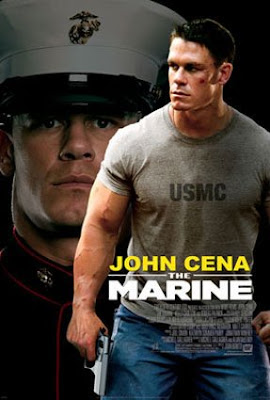
The Marine


Directed by John Bonito
Produced by Vince McMahon
Joel Simon
Written by Michelle Gallagher
Alan B. McElroy
Starring John Cena
Robert Patrick
Kelly Carlson
Music by Don Davis
Cinematography David Eggby
Editing by Dallas Puett
Distributed by 20th Century Fox
Release date(s) United States:
October 13, 2006
Australia:
June 28, 2007
New Zealand:
March 1, 2007
United Kingdom:
May 7, 2007
Running time 93 mins
Language English
Budget $23 million
The Marine is a 2006 action film starring professional wrestler John Cena. The film was directed by John Bonito, written by Michelle Gallagher and Alan B. McElroy and produced by Joel Simon.

Produced by the films division of World Wrestling Entertainment, called WWE Films, and distributed in the United States by 20th Century Fox, the film received a PG-13 rating from the MPAA for "intense sequences of violent action, sensuality and language". However an unrated version was released on DVD and Blu-ray.

Cast
Actor/Actress Role
John Cena as John Triton
Robert Patrick as Rome
Kelly Carlson as Kate Triton
Anthony Ray as Parker Morgan
Abigail Bianca as Angela

Damon Gibson as Vescera

Plot
After returning home from Iraq, ex-Marine John Triton (Cena), and his wife Kate (Carlson) decide to take a vacation. Meanwhile, criminals Rome (Patrick), Angela (Bianca), Morgan (Parker),and Vescera (Gibson) rob a jewelry store. While running from the cops, they stop at a gas station, where John and Kate have stopped as well. When the cops arrive to get gas, Morgan shoots one and Rome injures the other one. After Verscera knocks John out with a fire exstinguisher, Kate is kidnapped. Morgan shoots at the gas tanks, causing the store to blow up with John inside. John comes out alive, and takes the cop car. He chases after them, with every single member shooting at him. They go through a construction path, and to the edge of a lake. Under heavy fire, John falls out the car and into the lake. With Kate thinking John is dead, Rome and his crew travel through the woods, dragging a bound Kate with them. John comes out of the lake and follows them through the woods to save Kate.

Ratings
Australia: M
Brazil: 18
Canada: 14A
Canada (Quebec): 13+
Finland: K-15
Germany: 16
India: U/A
Philippines: PG-13
Portugal: M/12
Singapore: PG
United Kingdom: 15
United States: PG-13

Production
The script for The Marine was originally written Hollywood Heavyweight Academy Award Winner Al Pacino in mind for Rome. After Austin and WWE parted ways in 2004, the role of John Triton was given to John Cena. Al Pacino turned down the role of Rome due to low salary. After Pacino turned it down, Patrick Swayze was considered for the role of Rome, which was given to Robert Patrick.

Principal photography for the film was actually shot and completed in 2004. In order to cover for John Cena's absence from WWE events a storyline was written after Carlito beat Cena for the United States Championship, saying that he was stabbed by Jesús, the bodyguard of Carlito and was taking time off to recover.

Filming was done at Movieworld in Gold Coast, Queensland, Australia. The Marine Base was filmed at Bond University. The part in which skyscrapers are shown is the downtown area of Brisbane, Australia, in addition to being filmed throughout the outer areas of the metropolitan area in bush land.

The footage of an airplane landing is of Iran Air.

Release
Originally planned for a January or February 2006 release, it was later moved to Spring 2006, then September 8 (which was changed because former professional wrestler The Rock's Gridiron Gang was released September 15). It was finally released to theaters on October 13, 2006.

The film was released on DVD on January 30 2007. It is available in "Rated" and "Unrated" versions. The Blu-ray version was released on February 13, 2007, with a DTS-HD Lossless Master Audio 5.1 track and a 1080p HD transfer. The Region 2 DVD was released in the UK on May 7, 2007.

Box office performance
In its first week, the film made approximately $7 million at the United States box office.[1] In its first weekend, it placed #3 in domestic sales. On October 22, 2006 BoxOfficeMojo.com reported that The Marine had dropped to #9, grossing $3.75 million. Even so, ratings were poor, and the movie garnered a 21% rating from RottenTomatoes.com.

After a total of ten weeks in theaters, the film grossed $18.7 million domestically.[1] Worldwide, The Marine earned $20,226,432.

The Marine is noted as being WWE Studios's most successful film to date, beating out its predecessor See No Evil, starring Kane and its successor The Condemned, starring Stone Cold Steve Austin.

Reception
The movie was largely panned by critics,[2] Jim Slotek of the Toronto Sun referred to it as "a movie so dumb, it may actually cause brain damage."[3] Critics have also complained about the movie's reductive dramatization of Marine operations in Iraq, [4] and its lack of respect for the military. [5]A sequel to "The Marine" is in production and stars Ted DiBiase, Jr. Release date has yet to be confirmed.

DVD Sales
The Marine was the #1 most rented DVD in its first week of release.[6] By March 2007, it had made over $24 million in home sales and rental.[7] Overall, the film made $30 million in rentals in the first twelve weeks.

Aston Martin DBS


Just Think ‘007’ and Add $269,993

2009 Aston Martin DBS.

By LAWRENCE ULRICH
Published: November 26, 2008, New York Times
STARTING in 1965 with the DB5 in “Goldfinger,” Aston Martin has been linked at the tuxedoed hip with James Bond; gadget-packed Astons have been driven by Connery, Lazenby, Dalton, Brosnan and Craig.

The shift lever is placed a bit too far rearward on the console for ideal shifting, but the lever itself is easy and precise.

Inside and out, the DBS sets a serious tone.

But given the economy, anyone who can still afford a $270,000 Aston Martin DBS might inspire a real-world film, with enough supervillains and world domination to make 007 quiver. Call it “The Man with the Golden Parachute.”

Wafting above the crowd is certainly the point. With 510 burbling horsepower from the V-12 power plant, angry stockholders vanish in the mirror. Seething mobs of the unemployed are drowned out by the 1,000-watt Bang & Olufsen sound system.

C.E.O.-envy aside, the roughly 300 Americans who will drive home a DBS this year need to know the score. First, ignore the self-appointed accountants who have questioned why the DBS costs $100,000 more than the Aston DB9. I mean, these people drive Hondas.

The DBS and DB9 share a lightweight aluminum chassis and the 5.9-liter engine block under their stretched hoods. But the DB9 has been around six years, a virtual eternity for people who want the latest and greatest. Second, the lovely DB9 — designed by Ian Callum before he cribbed from himself to create the Jaguar XK — looks even more Jaglike next to this muscled-up Adonis.

The DBS isn’t just one of the world’s prettiest cars. It pulls off the tricky feat of looking insanely fast and expensive without rubbing everyone’s nose in it. For all its power — a 4.2-second eruption gets you to 60 m.p.h.; top speed is 191 — the Aston is a classic GT, a proper Brit with a noblesse oblige you won’t find in a flaming yellow Lamborghini.

That Aston heritage dates to 1914, but it took Ford to revitalize the moribund company. After 13 years of full ownership, Ford sold out last year to a consortium backed by Kuwaiti oil investors and led by David Richards, a British motorsports entrepreneur.

I spent my first day with the DBS balancing euphoria with skepticism. I figured it would drive like any traditional Aston: a buttery high-speed cruiser with a concert-hall V-12, but too soft and gentlemanly to sully itself on twisty roads.

Instead, after a warm-up, the Aston sliced through the countryside like an English football hooligan, but with a better singing voice.

A dashboard switch maxes out the computer-controlled shocks for high-speed duty, keeping the Aston’s body pinned to the ground like a manhole cover. The standard ceramic composite brakes — which can cost up to $15,000 extra on other exotic cars — could stand a bit more initial bite, but were triple-espresso strong.

An honest-to-God manual shifter — increasingly rare in cars of this caliber — amplified the fun. The lever is placed a bit too far rearward for ideal shifting, and the clutch’s iffy take-up requires practice for smooth starts. But the lever itself is easy and precise, topped with a slab of cool metal. A paddle-shifted automatic is an option.

Then there’s that engine, which sounds like money being torn in two. A valve in the exhaust system cocks open under heavy throttle to release the battle cry of the V-12. On that note, the DBS got a dismal 12 m.p.g.

On this car, pretty much everything that isn’t lightweight aluminum is even more expensive carbon fiber, from the featherweight hood and interior door trim to the angry-looking aerodynamic diffuser at the rear. It adds up to a relatively svelte 3,737 pounds, about 100 fewer than the main competitor, the $310,000 Ferrari 599 GTB Fiorano.

Swan doors swing open on a slightly upward angle, clearing curbs that would gouge the typical low-slung sports car. High sills make for body-scrunching entry and exit, but it’s worth it once you’re inside. Semi-aniline leather and a suede headliner were a perfectly matched deep red, making the cabin look like a boutique bordello.

Gauges look as fine as a Swiss chronograph. But while I’ve gotten used to the strange tachometer that spins counter-clockwise, there’s still no red line to show peak engine speed. How much could it cost to paint a red stripe on that thing?

Other nitpicks, just to make clear that I’m not a total sucker for beauty: lumbar controls are buried between the seats and console in a “Where’s Waldo?” arrangement. A cheap-looking navigation screen rises from the dash like a ghoul from the crypt of Kia. And the key is called the Emotion Control Unit, which is appropriate since it forced me to keep my temper in check. This fiddly chunk of genuine sapphire and stainless steel must be inserted into a slot just right or the car won’t start.

There’s a small parcel shelf in the rear but owners can opt for a tiny back seat instead — for children who haven’t been sent to boarding school.

Buyers seeking unrivaled GT performance may choose the 612-horse Ferrari. The 599 GTB is decisively faster than the Aston and its handling is a bit purer. But in my view, the 599 GTB — which even zealots wouldn’t cite as an all-time great Ferrari design — can’t beat the Aston’s looks.

Such fantastical comparisons tend to embarrass me anyway; it’s like asking which superhero would make the best and fastest sushi chef. (My money’s on Aquaman.)

Still, most car fans, including auto writers, keep a fantasy list of cars we imagine we’d buy if we struck it rich. For what it’s worth, the DBS is the first Aston GT to make it onto my mental bedroom wall. Surely there’s no harm in wondering how much a used DBS will fetch in 10 years.

Sunday, November 30, 2008

Steamboat Itchy

Itchy & Scratchy


The Itchy & Scratchy Show title card.

Format Animated Children's show
Created by Chester J. Lampwick
Starring June Bellamy
Homer Simpson (1997)
Country of origin United States
No. of episodes 80
Production
Executive
producer(s) Roger Meyers, Jr.
Krusty the Clown
Running time 30 sec.
Broadcast
Original channel Channel 6
The Itchy & Scratchy Show is a segment or "side-show" featured on The Simpsons which usually appears as a portrayal of the fictional Krusty the Clown TV show, watched regularly by Bart and Lisa Simpson and other characters on the animated series. Itself an animated cartoon, The Itchy & Scratchy Show depicts an anthropomorphic blue mouse, Itchy (voiced by Dan Castellaneta) who mutilates an anthropomorphic black cat, Scratchy (voiced by Harry Shearer).

They first appeared in the Tracey Ullman Show short "The Bart Simpson Show", which originally aired November 20, 1988. Their first appearance in the regular series was "There's No Disgrace Like Home".

Itchy and Scratchy subvert the "cat versus mouse" archetype popularized by Tom and Jerry in that there is no explicit aggressor; instead, both cat and mouse act as aggressors on occasion.[citation needed] Itchy and Scratchy features more gore and injury than its predecessor, in a send-up of the cartoon violence present in the original.[citation needed]

Contents [hide]
1 Fictional history within The Simpsons
1.1 Origins
1.2 "Past"
1.3 "Present"
1.3.1 Poochie
1.4 The Itchy and Scratchy Movie
1.4.1 The Simpsons Movie
2 Role in The Simpsons
3 Background
3.1 Origins
3.2 Development
4 Cultural influence
4.1 Video games
5 See also
6 References
7 External links

Fictional history within The Simpsons
Origins
The Itchy & Scratchy Show writing staff, caricatures of the staff of The Simpsons, along with Roger Myers Jr., Krusty and the prototype Lindsey Naegle. As shown in "The Itchy & Scratchy & Poochie Show".According to the show, Chester J. Lampwick invented Itchy in 1919 and owns the rights to that character. Lampwick was also known as the "father of cartoon violence." (Before Lampwick started his work, cartoon animals only played the ukulele.) Roger Meyers, Sr. (1890–1985) plagiarized Itchy and established Itchy and Scratchy Studios in 1921. Originally Itchy was called "Itchy the Lucky Mouse" (a parody of Oswald the Lucky Rabbit).[1] He starred in his first cartoon made by Lampwick, "Manhattan Madness" depicting Itchy running an Irishman through a washing board and decapitating Theodore Roosevelt with an axe.

Scratchy starred in his first cartoon in 1928, entitled That Happy Cat. The film, which is about fourteen seconds of animation showing the cat whistling and tipping his hat, did very poorly. It is unknown who created Scratchy, or if he was plagiarized by Meyers Sr. in the same way that Itchy was.

Later that year, Itchy and Scratchy starred in their first cartoon together entitled "Steamboat Itchy" a violent parody of Disney's Steamboat Willie featuring Mickey Mouse.

"Past"
Since The Simpsons exists in a form of floating timeline, "past" refers to events that occurred before the course of the series.

Along with the cartoon shorts, Itchy and Scratchy were featured in a wartime radio series,[2] at least two films - Pinitchio and Scratchtasia, (parodies of Pinocchio and Fantasia),[3] and television commercials for Laramie Cigarettes (spoofing The Flintstones).[4]

At one point, additional characters were added to the pair on a show titled Itchy & Scratchy & Friends Hour: Uncle Ant, Disgruntled Goat, Dinner Dog, Flatulent Fox, Ku Klux Klam, and Rich Uncle Skeleton. Bart and Lisa agree that these characters weren't very funny, although Bart (who remembers them better, as he is the older of the two) thinks that Disgruntled Goat had his moments. These characters parodied the addition of superfluous characters to TV shows in an effort to draw viewer interest.[3]

"Present"
Since The Simpsons exists in a form of floating timeline, "present" refers to events that occurred during the course of the series.

Itchy and Scratchy Studios is currently run by Roger Meyers, Jr. (born 1956), the son of the cartoon's "creator." Itchy and Scratchy Studios was bankrupted after being sued by Lampwick for $800 million, but was saved after receiving a large cash settlement from the government over its use of Mr. ZIP.[1]

The Itchy and Scratchy Show airs as a segment on the Krusty the Klown show, though it moved to the Gabbo show during the latter's short-lived run.[5] The show underwent a non-violent retooling following a protest campaign led by Marge Simpson, but after Marge was later discredited, it returned to its original violent format.[6] The show has spawned an Academy Award-winning film adaptation,[7] amusement parks,[3] and a musical.[8]

The show is animated in South Korea, just like The Simpsons cartoon itself. June Bellamy (a takeoff on voice actress June Foray) voices both Itchy and Scratchy.[9]

Poochie
In the episode "The Itchy & Scratchy & Poochie Show", Poochie was a dog character added to the Itchy & Scratchy lineup. According to the show's plot, the producers believed the cartoons were getting stale, and needed a new character to reinvigorate the show, despite the objections of one of the show's writers, who "at the risk of sounding pretentious", felt that Itchy and Scratchy comprised "a dramaturgical dyad". Homer Simpson gets the job of voicing Poochie, who is introduced in the Itchy & Scratchy cartoon, The Beagle Has Landed. A product of marketing department thinking, Poochie was near-universally despised, and was killed off in his second appearance, despite Homer's objections. Both plots were a reference to TV shows which added new characters purportedly to reinvigorate the show (often in the show's waning years and/or to replace stars who had either departed or, if they were child actors, grown up). However, Poochie was seen and spoke in the second segment of "Treehouse of Horror IX", where he was seen riding on a skateboard down the road and suddenly get hit by Itchy & Scratchy chasing Bart and Lisa Simpson. Dan Castellaneta again voiced Poochie for this appearance. Another Poochie appearance was made as one of Scratchy's mourners in the installment Tears Of A Clone.

The Itchy and Scratchy Movie
The title card for The Itchy & Scratchy Movie.In the season four episode, "Itchy and Scratchy: The Movie," the cat and mouse duo release a movie that ran for eight months, becoming a commercial and critical favorite. Forty years in the future, it would be hailed as a "Classic of Animation". The novelization of the movie was written by Norman Mailer. Lisa described it as the defining event of her generation and compared it to the moon landing. One scene involves Itchy training to be a railroad engineer for the sole purpose of running Scratchy over with a train.[10]

The Simpsons Movie
At the start of The Simpsons Movie, the Simpson family are seen attending another Itchy and Scratchy movie. In this movie, Scratchy and Itchy go to the moon, but Itchy stabs Scratchy repeatedly with the point of an American flag then leaves him for dead. Itchy then moves on to go back to Earth and become President and to raise a happy family. But then, one day, Itchy finds out that Scratchy is still alive, and is threatening to expose the truth (Itchy told the media that Scratchy died of an accident and that he "tried to save him"). Itchy contemplates over how to deal with Scratchy and decides to blow up the moon with nuclear arms launching a bunch of missiles into Scratchy's open mouth causing him to inflate, a tiny boot kicks one of the missiles in Scratchy's stomach causing them all to detonate and to blow Scratchy up from the inside. Homer then interrupts the movie and breaks the fourth wall by saying “Everyone in this theatre is a giant sucker, especially you!” and pointing to the audience.

Role in The Simpsons
Many aspects of The Itchy & Scratchy show are a parody of Walt Disney movies and include shorts such as "Steamboat Itchy", a parody of Steamboat Willie; "Scratchtasia", a parody of Fantasia; and "Pinitchio", a parody of Pinocchio.[11]

Itchy and Scratchy often play out an exaggerated form of the conflict in the surrounding episode. For example, when the Simpson children are taken into foster care, they watch an Itchy and Scratchy cartoon with a similar theme[12], and when Homer is recruited by NASA, he watches an Itchy and Scratchy cartoon which directly (and gruesomely) parodies the films 2001: A Space Odyssey and Alien.[13]

Itchy and Scratchy have occasionally been used to parody the work of famous directors specifically. One episode, "Reservoir Cats" is supposedly guest-directed by Quentin Tarantino and parodies Tarantino's films Reservoir Dogs and Pulp Fiction. Another cartoon was "guest directed" by Oliver Stone and shows Itchy shooting Scratchy in a manner similar to Jack Ruby's murder of Lee Harvey Oswald, in reference to Stone's film JFK.

In the episode "The Day the Violence Died" there was a clip from a 1970s-era X-rated Itchy & Scratchy cartoon titled "Itchy & Scratchy meet Fritz the Cat". According to Comic Book Guy only bootleg copies are available "because of its frank depiction of sex and narcotic consumption".

Background
Origins
The Itchy & Scratchy Show first appeared in the Tracey Ullman Show short "The Bart Simpson Show", which originally aired November 20, 1988. They are based on Tom and Jerry and other cat and mouse cartoons. As a kid, series creator Matt Groening and his friends would fantasize about an ultra violent cartoon and how much fun it would be to work on a show like that.[14] The names "Itchy" and "Scratchy" were inspired by "Pixie and Dixie", who were mice on the cartoon show Pixie and Dixie and Mr. Jinks.[14] David Silverman, a director and producer for The Simpsons, states that the show is based on Herman and Katnip.[15]

Development
"Itchy and Scratchy" cartoons are often added when a show needs expanding[16] or when there is an issue that the writers wish to satirize.[17] The shorts are often hard for the writers and take a long time to develop and come up with a title for the short and in the end they do not fill up a large amount of time.[18] Writing the Itchy & Scratchy cartoons is quite often a group effort, with it being pitched out one gag after another.[19] Itchy & Scratchy are a favourite of John Swartzwelder, who has written many of the episodes that centre around them and quite often pitches the ideas for the shorts.[18] In several episodes centering around the production of The Itchy & Scratchy Show, such as "The Itchy & Scratchy & Poochie Show", the show's staff are shown. Almost all of them are caricatures of the actual staff of The Simpsons. In the first scene at the production table the person in the lower right corner, wearing a squid T-shirt, is David X. Cohen. On the left side, the furthest away is Bill Oakley with Josh Weinstein next to him. Next to Weinstein is George Meyer, who is the writer who speaks out and gets fired. The animator shown designing Poochie is supervising director David Silverman. Others who appear include Dan McGrath, Ian Maxtone-Graham, Donick Cary, Ron Hauge, Ned Goldreyer and Mike Scully, who had to be added in later, as the animators "didn't have his photo" from which to get an accurate likeness.

Cultural influence
In a 2006 article IGN.com ranked Itchy & Scratchy in tenth position on their list of the "Top 25 Simpsons Peripheral Characters", citing that "the Itchy & Scratchy Show shines a nice mirror on cartoons, showing just how funny cartoon violence really is."[20] In 2007, Vanity Fair named "The Itchy & Scratchy & Poochie Show" the sixth best episode in the show's history, describing it as "a classic satire of network influence, obsessed TV fans, and programs that survive long after the shark has been jumped, the episode is a meta-celebration, a tongue-in-cheek rebuttal to everyone who claimed that the quality of The Simpsons had declined over the years."[21] Todd Gilchrist called it a masterpiece, stating it "could easily be packaged and sold by [itself]."[22] Comic Book Guy's phrase "Worst. Episode. Ever" was named as a quote that could be used in everyday life, as well as being one of the most popular quotes from the show, by The A.V. Club.[23]

Video games
A video game named The Itchy and Scratchy Game was released for Sega Mega Drive, Game Gear, Super NES and Game Boy.[24] Another game, Itchy and Scratchy in Miniature Golf Madness, was released for Game Boy.[25] A level of the SNES/Genesis game Bart's Nightmare also prominently features Itchy and Scratchy. In The Simpsons Hit and Run, if you cllect all of the collectible cards, you can then go and watch a 3D Itchy and Scratchy episode. Itchy and Scratchy play roles in "Grand Theft Scratchy" section in The Simpsons Game.